Volume: 75 Issue: 1
Making Artificial Roosts More Habitable for Bats
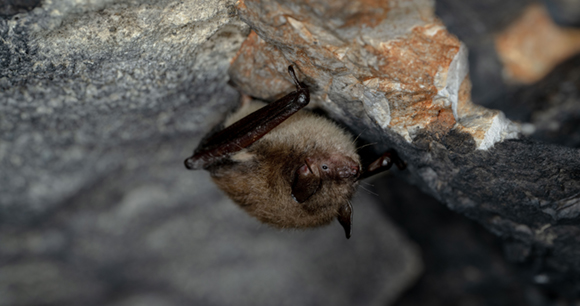
Many bat species use human-made structures for nightly roosts due to habitat loss from human causes. Disturbingly, recent research suggests that bats roosting in commonly used bat boxes often overheat during the summer due to size, box placement, and overcrowding, ultimately leading to mortality in vulnerable bat species. Though research has begun to define both the temperature limits of bats as well as what bat box designs can maintain temperatures within these limits, we have yet to assess how bats respond to the ambient temperature of bat boxes.
With funding from a Christine Stevens Wildlife Award, we developed an inexpensive electronic detection system that can be deployed on commonly used bat boxes to record the exact time a bat enters and exits a bat box. Each system consists of two passive infrared (PIR) sensors connected to a user-friendly microcontroller that records the time when the PIR sensor detects a change in infrared radiation, for example, when a bat enters or exits a box. By placing two PIR sensors at a specified distance apart, we can determine if the bat is entering the bat box (triggering the lower PIR sensor before the upper PIR sensor) or exiting it (triggering the upper PIR sensor before the lower PIR sensor). We included a clock and two temperature sensors to record the exact time and temperature inside and outside the bat box whenever the PIR sensor is triggered. Finally, we developed user-friendly code that will run the system and output the resulting temperature and time data.
We currently are testing the single system in the lab and then will deploy a total of 20 systems to field test on 20 bat boxes (10 single chamber, 10 rocket multichamber boxes) in the study area in Clarksville, Tennessee. These 20 bat boxes were placed on private properties to habituate bats to their presence and increase their usage by bats before our detection system is installed. Once field testing is complete, we will share the design, instructions, and code with the public and bat managers in order for this system to be widely deployed across North America. Using the temperature and time data collected from bats’ use of the boxes, we can assess not only how warm these bat boxes can become, but also how bats respond to the ambient temperatures of the boxes. The results from this study will help managers understand how artificial roosts may not be as suitable for bats as originally thought and how best to mitigate these stresses.
This study was funded by the Christine Stevens Wildlife Awards program. Learn more about this program or view additional studies.
See more AWI Quarterly articles about: Terrestrial Wildlife
See more AWI Quarterly articles of type: Feature Article